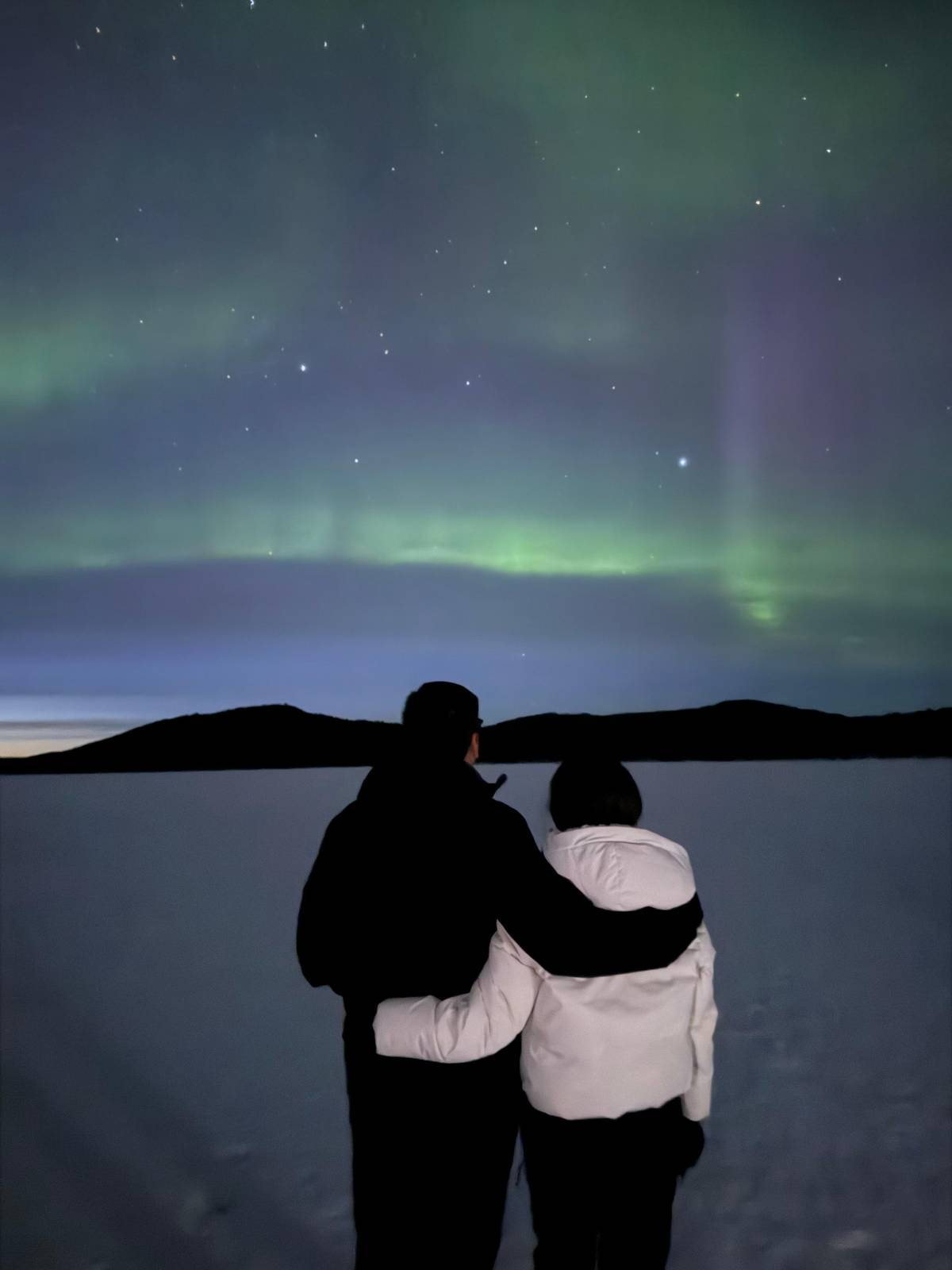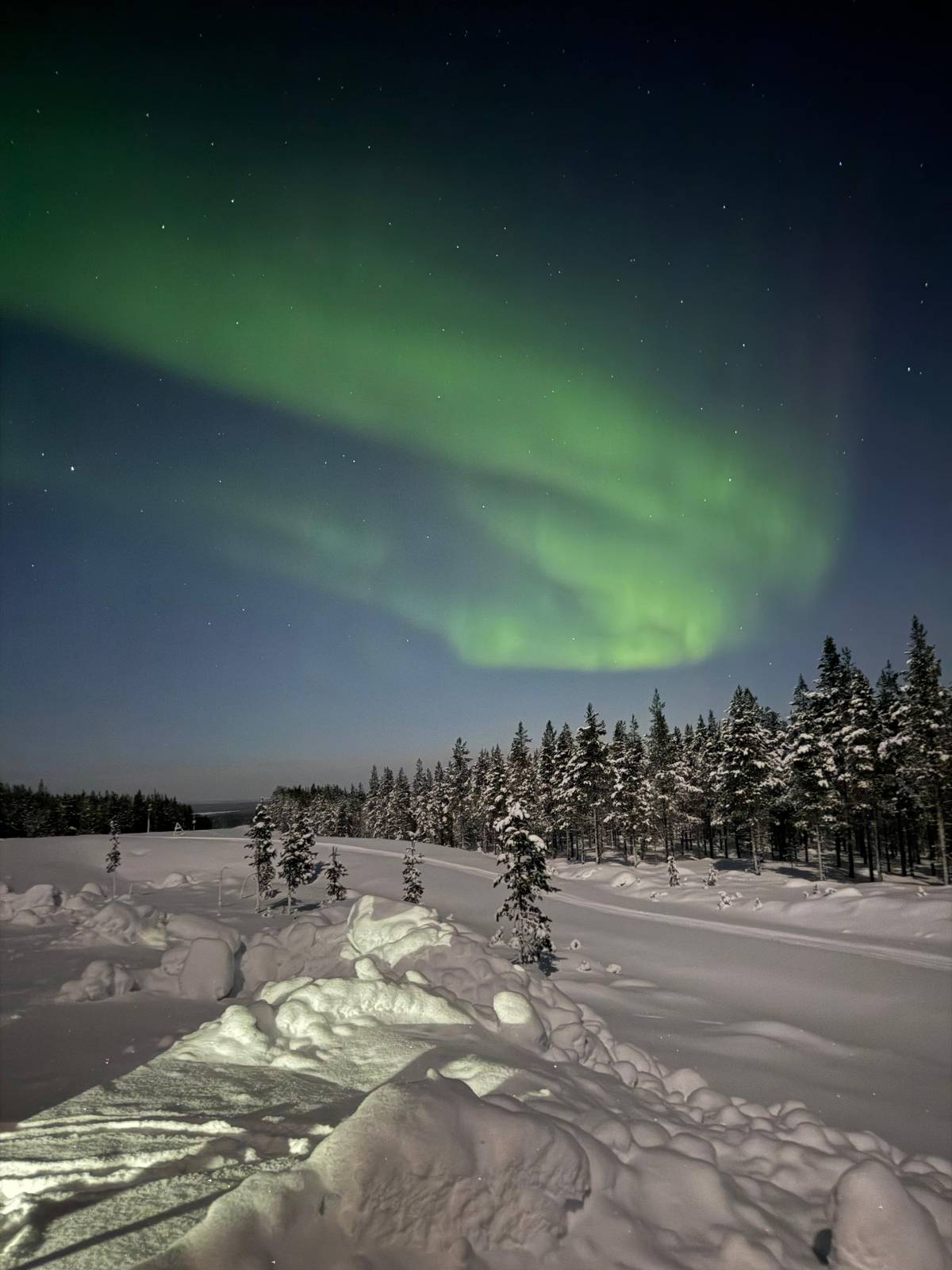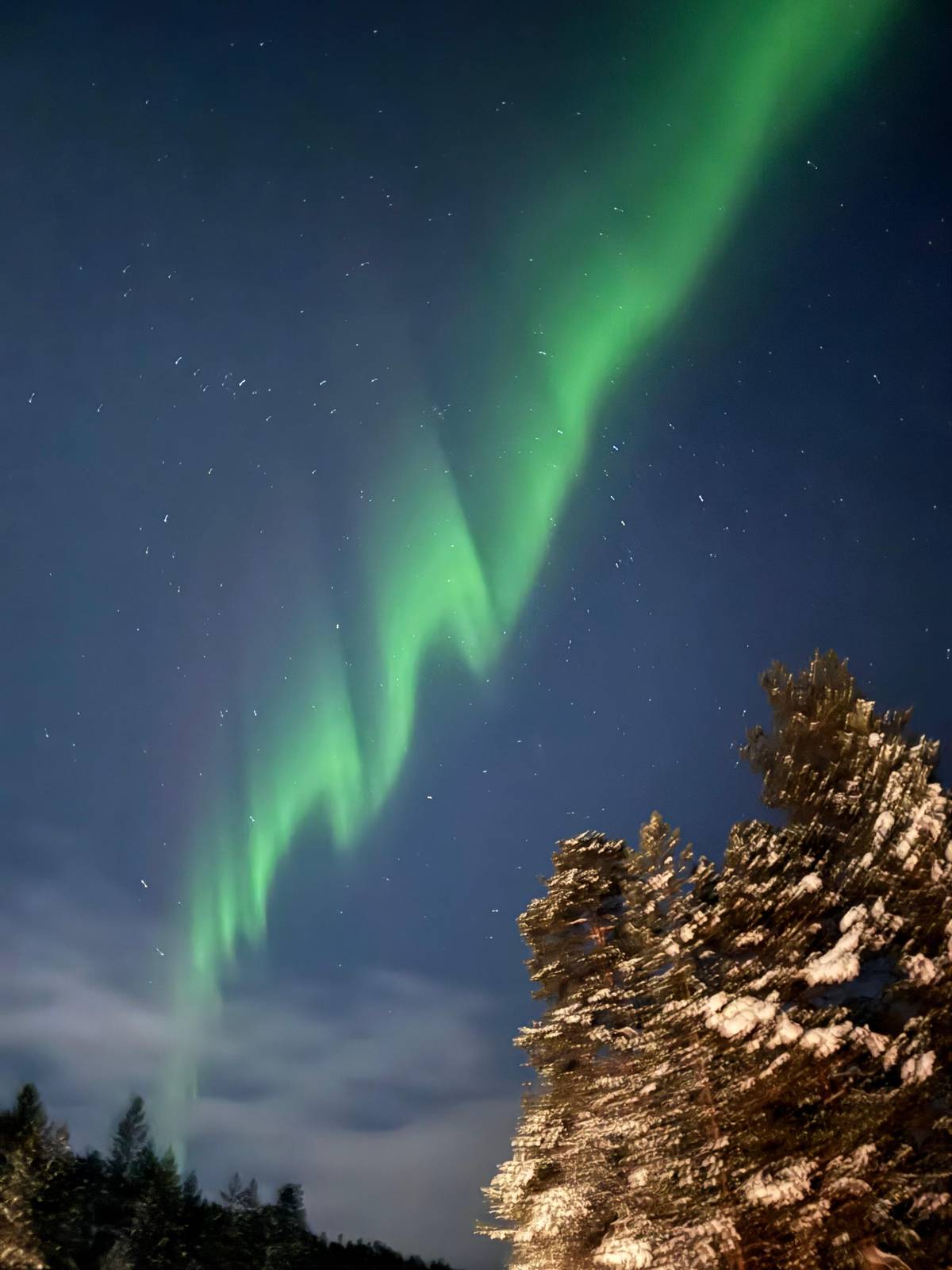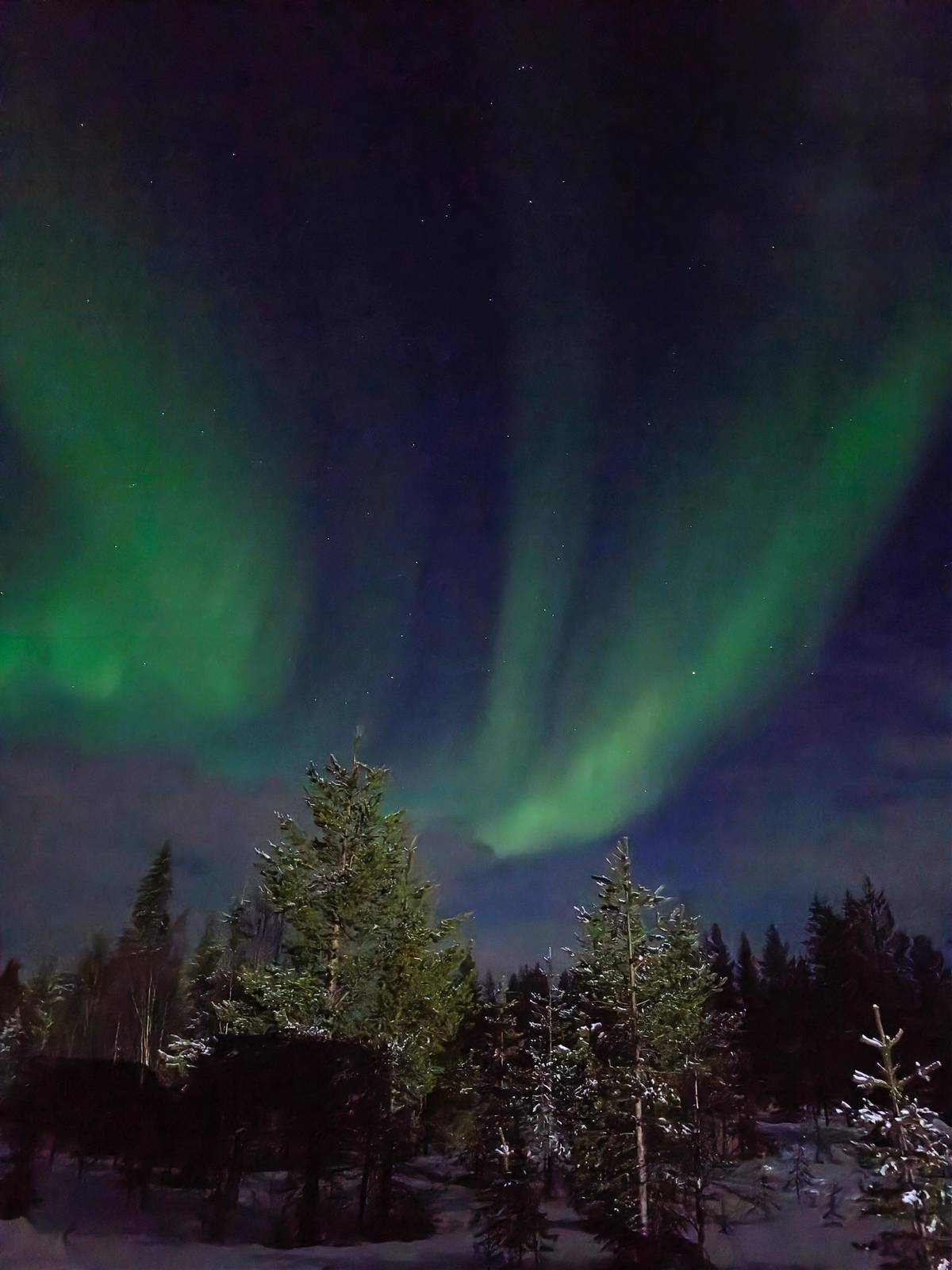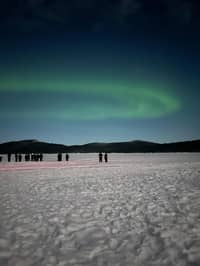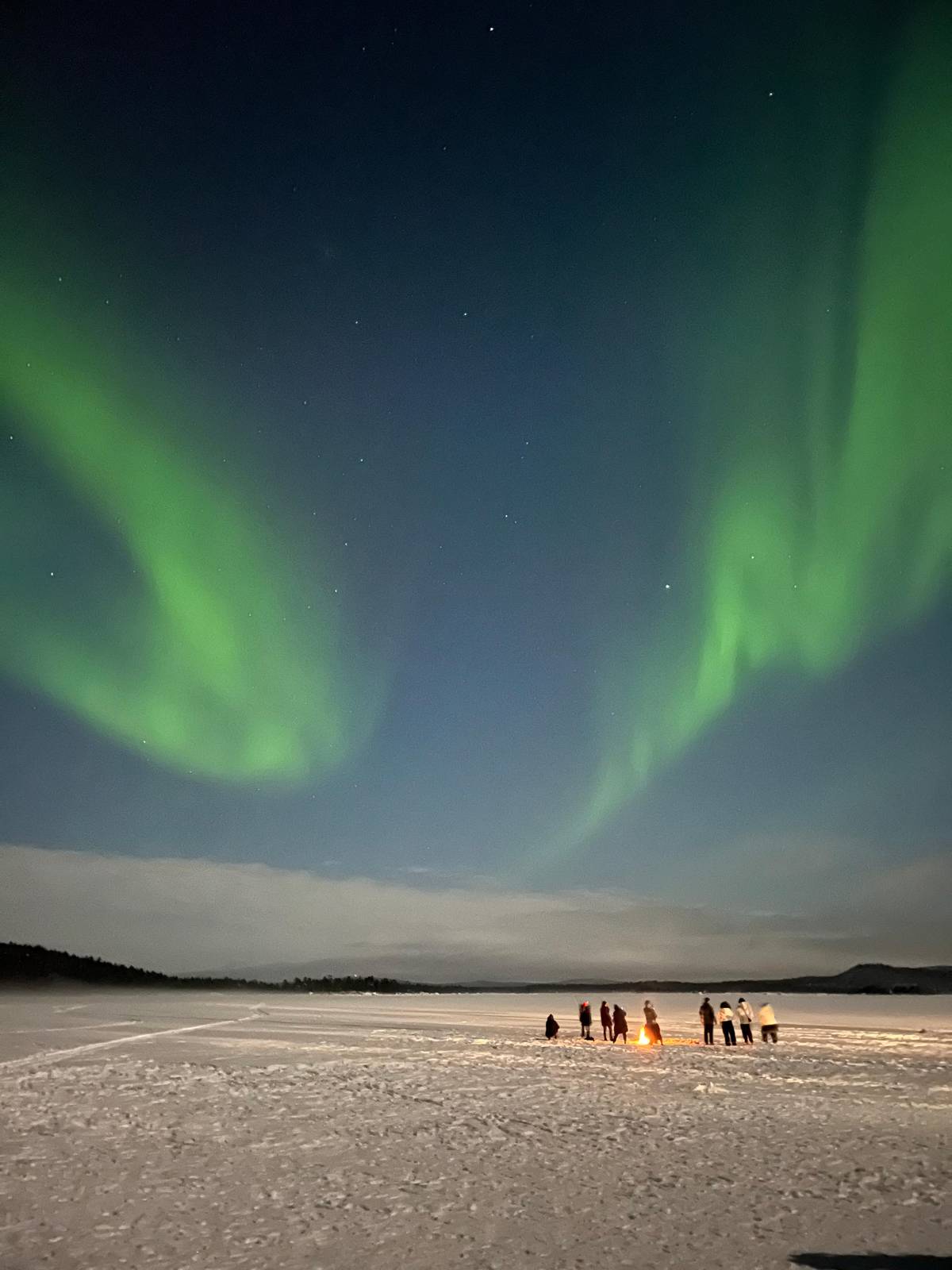
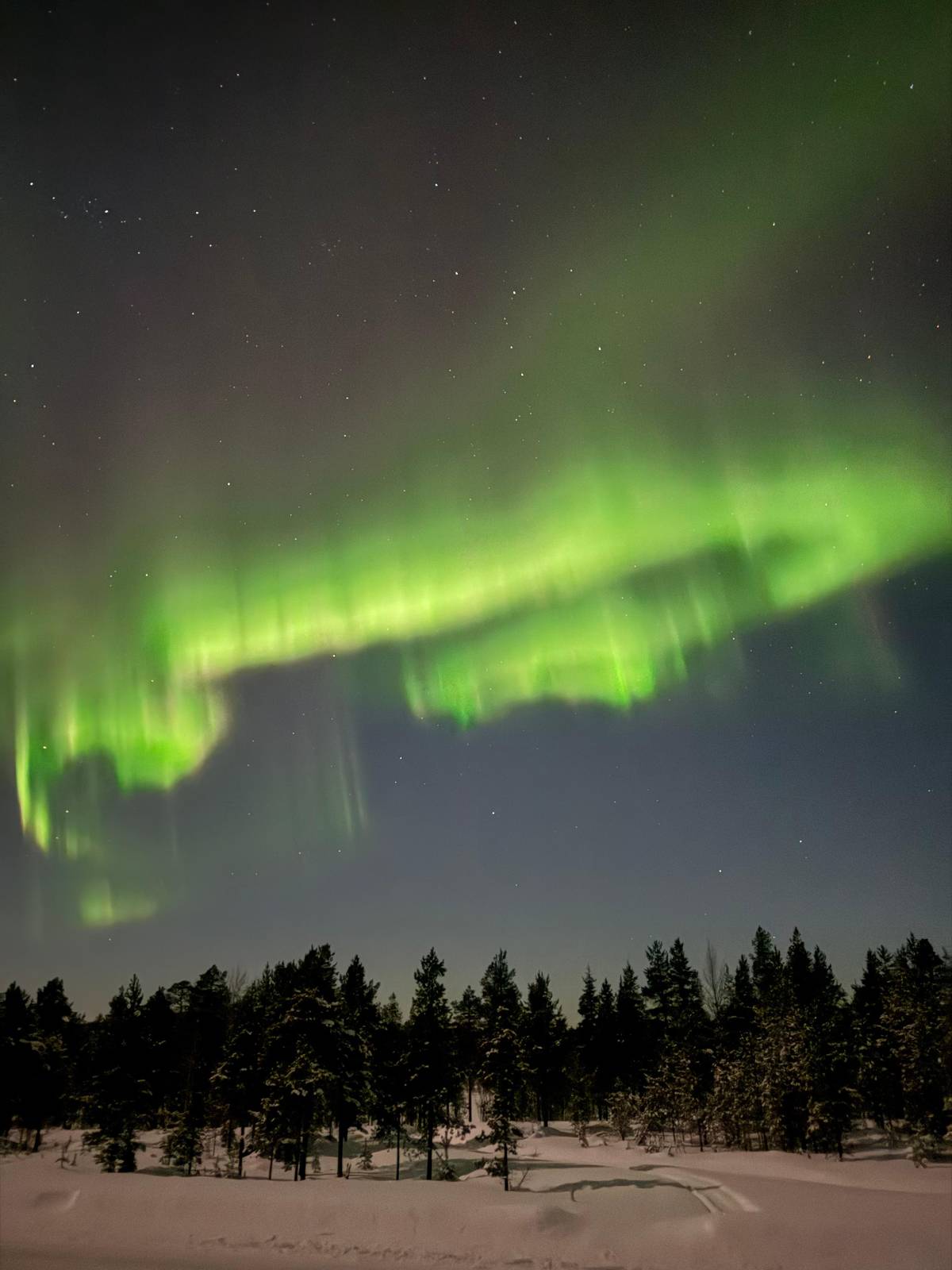
 Booked here
Aurora hunt by van
From Saariselkä
- Photos
- Pro camera, included
- Duration
- 3 hours
- Price
- from $160
Guides
Language
EnglishCurrency
US dollar · $GetYourGuide shows prices in the currency you choose.
Guide · Aurora photos
A phone with night mode, a camera on a tripod or a guide who photographs you: each works under the Lapland sky. Here is what to pack, how to set up in the cold and which tours around Saariselkä include photos.
Editorial team, saariselkanorthernlights.comUpdated October 19, 2026Reading time about 7 minutes28 sources
Quick answer
The best camera for Lapland is the one you can work with in the dark, with gloves on, while your breath fogs the screen. A recent phone with a night mode can record an aurora that looks brighter than what your eyes see. Visit Finland says a tripod and a camera or phone set to night mode might capture more than the naked eye alone.1 For many trips, a phone and a small tripod are a sensible start.
A system camera with interchangeable lenses gives you more control. A wide lens with a large aperture lets in a lot of light and fits a whole arc across the sky, and full manual control means the camera does not fight you by hunting for focus or brightening the snow. If you already own such a camera, bring it; if you do not, a holiday is a costly time to learn a new one in the dark at a frozen roadside.
Whatever you carry, practice before you fly. Learn where manual focus, exposure time and sensitivity live on your camera, and how to switch off the flash and the focus-assist lamp. Try a few frames on a dark evening at home, at night on a balcony or in a park. On the night itself in Lapland you will want to change settings by touch, with gloves on, not by reading a menu by torchlight.
At the spot
Before leaving
Lapland winters average -14 °C; keep spare batteries close to your body.4
On arrival
FMI advises about half an hour in the dark for night vision.5
Setting up
Auroras are most often seen on the northern sky, FMI says.2
First frames
A test frame shows whether a pale band is aurora or cloud; green is the most common color.6
Around midnight
FMI says displays are typical at midnight and a couple of hours either side.3
Back inside
Let it warm slowly in a sealed bag to keep condensation off the lens.
Put the camera on a tripod and set it to manual. Set focus to infinity, check it against a bright star or a far-off lamp, then tape or lock the ring once it is sharp. Start with a long exposure, a wide-open aperture and a raised sensitivity, take one frame and judge it on the screen: if the sky is a smear, shorten the exposure; if it is dark and grainy, lengthen it or open up. Shoot in RAW if your camera allows it.
Point toward the north first. FMI notes that auroras are most often seen on the northern sky and advises an unrestricted view at least toward the northern horizon.2 Include something on the ground, a snow-loaded spruce, a frozen lake shore or your friends, to give the picture a sense of place. When the display moves overhead, turn the camera upward and let the arcs fill the frame.
Keep your own eyes ready too. FMI says human night vision is not very good and advises staying in the dark for about half an hour while the eye adapts.5 Dim the camera screen and avoid white torchlight; a red headlamp or a phone at its lowest brightness keeps your night vision and does not spoil other people's photos. Some tours ban flash and flashlights outright. Check the rules before you set off.
Guest ratings
Kit list
| Item | What it does | Lapland tip |
|---|---|---|
| Tripod | Holds long exposures steady | Extend the legs before your fingers get cold |
| Wide, bright lens | Fits a whole arc, gathers light | Set focus at infinity and lock it |
| Spare batteries | Cold drains them fast | Carry them in an inside pocket |
| Phone with night mode | Light, quick, easy | Rest it on a small tripod or a mitten |
| Red headlamp | Lights the controls softly | Protects your night vision and others' photos |
| Liner gloves | Lets you press small buttons | Wear them under warm mittens |
General kit advice; Visit Finland names a tripod and a camera or phone in night mode, and winters average -14 °C.14
Let someone else shoot
Booked hereFrom Saariselkä
 Learn to shoot
From Inari or Ivalo
 Most in depth
From Ivalo
Decision helper
Match the option to how much you want to shoot yourself
Visit Finland says a phone in night mode on a tripod might capture more than the eye.1
Photography with a professional camera is included.
The Inari and Ivalo hunt by car includes a short photography lesson.
It covers science, forecasting and photography of the aurora.
The snowmobile hunt's guide shares tips and the listing encourages your own camera.
If you want to photograph what you see, a tripod and a camera or phone set to night mode might capture more than the naked eye alone.
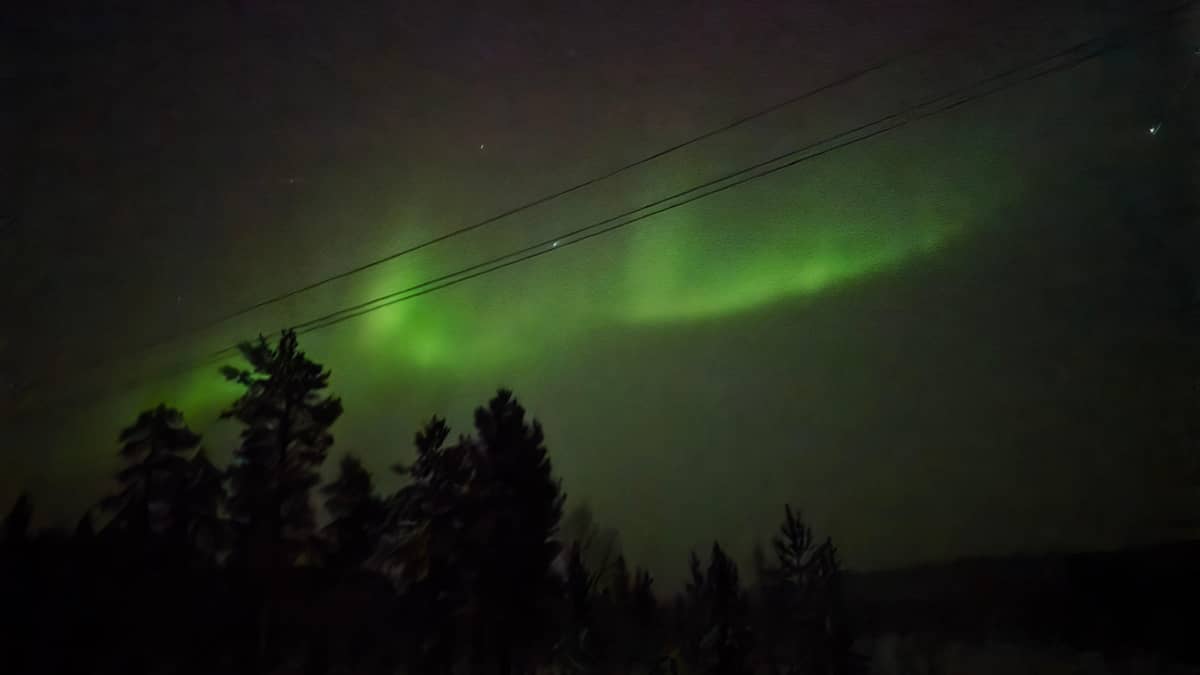
Green dominates. Visit Finland says green is by far the most common aurora color, produced around 100-300 kilometres up.6 NOAA traces the pale green to atomic oxygen, at a wavelength of 557.7 nm.7 Cameras often record this green more strongly than the eye, and a faint grey glow can turn bright on the screen. Use that to your advantage: a test frame shows you whether a dim band is aurora or just cloud.
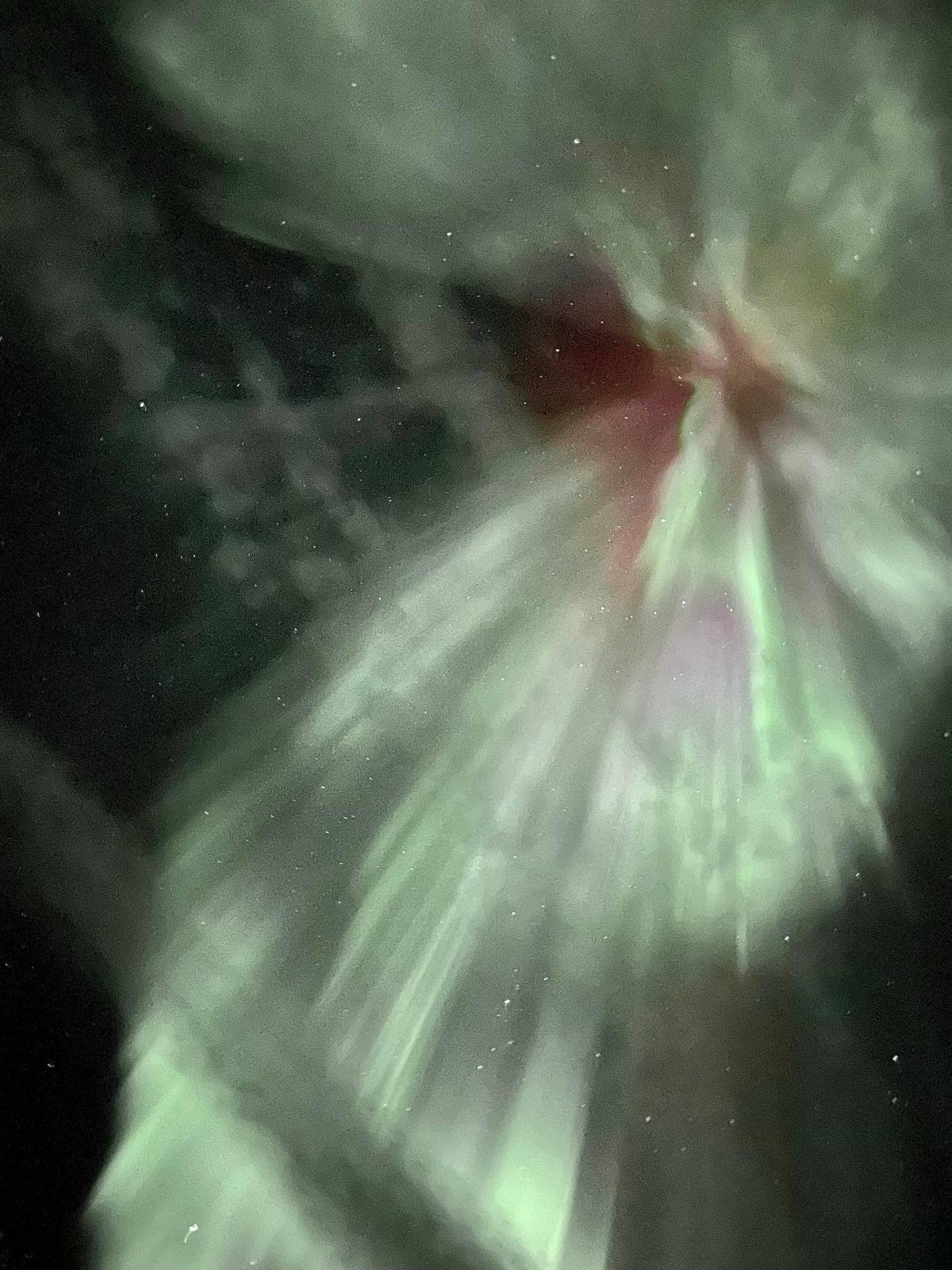
Other colors are rarer. Visit Finland says pink and violet appear during stronger activity, while red is rarer still and forms higher in the atmosphere.6 NOAA places red aurora from oxygen above 300 km, and explains that the purplish lower border sometimes seen comes from molecular nitrogen.89 A short exposure during a fast display keeps that pink fringe crisp instead of washing it into the green.
White balance changes the mood more than you might expect. A warm setting turns the sky muddy, while a cooler one keeps the snow white and the aurora clean. Shoot RAW and you can decide later at home. Resist the urge to push the saturation hard in editing; a natural green next to blue snow and dark spruce looks more convincing than a neon sky, and it stays closer to what you actually saw.
Map
Saariselkä next to the other aurora bases of Finnish Lapland, then a closer look at the fells, the airport and Lake Inari north of the village.
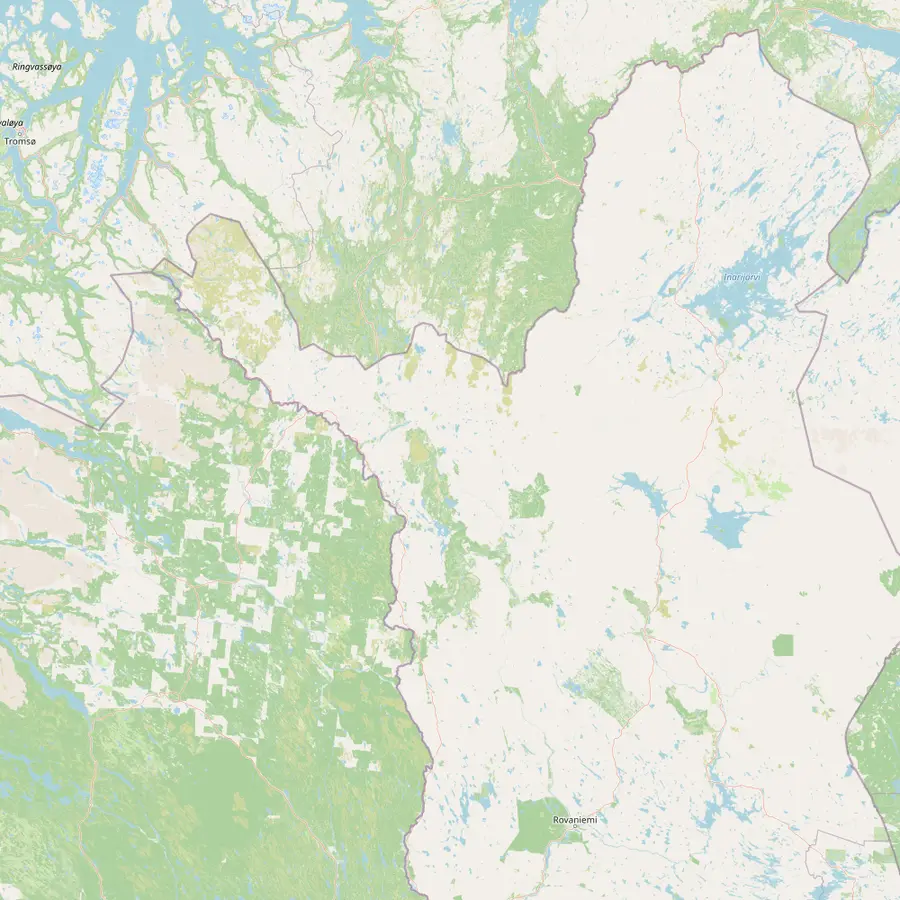 1Saariselkä2Ivalo3Inari4Utsjoki5Kilpisjärvi6Levi7Rovaniemi
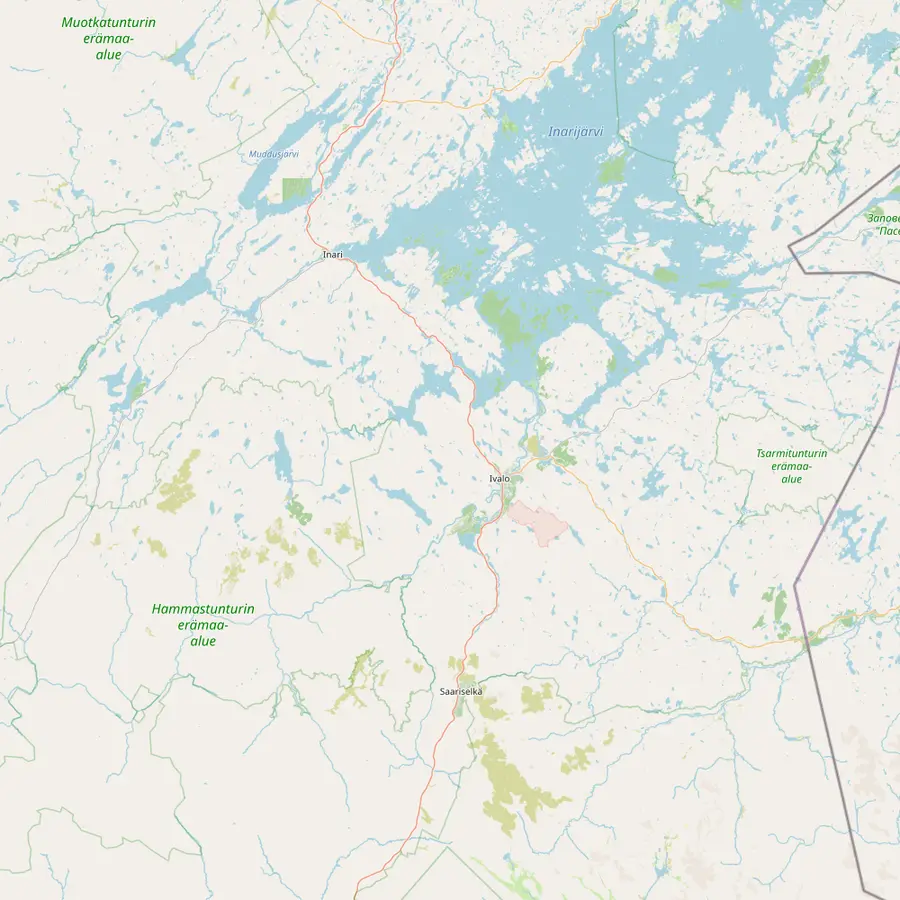 8Kaunispää9Kiilopää10Kakslauttanen11Ivalo Airport2Ivalo3Inari12Lake Inari
FMI counts Saariselkä among the Lapland resorts where aurora shows on roughly 50 % of dark, cloudless nights.10
In Google Maps ↗Home of the northernmost airport in Finland and the EU.11 Some aurora hunts start from here.
In Google Maps ↗A village on Lake Inari, in a municipality where three Sámi languages are in official use.12
In Google Maps ↗On the northern border: FMI statistics give auroras on three nights out of four here, and the polar night lasts almost two months.1314
In Google Maps ↗FMI's highest figure for Finland: aurora on about 75 % of dark, cloudless nights.15
In Google Maps ↗About 170 km north of the Arctic Circle and 15 km from Kittilä Airport.1617
In Google Maps ↗On the Arctic Circle itself, with auroras from late August to the end of March or early April.1819
In Google Maps ↗Saariselkä's own fell, 438 metres, reached on foot, on skis, by car or by ski lift.20
In Google Maps ↗A 546-metre fell at a gate of Urho Kekkonen National Park.21
In Google Maps ↗The glass igloo resort, which places itself 250 km above the Arctic Circle.22
In Google Maps ↗Only 7 kilometres from Ivalo village, with daily flights.23
In Google Maps ↗Finland's third largest lake, with some 3,318 islands.24
In Google Maps ↗Checklist
Cost calculator
Starting totals for your group on tours that include photos or tips.
Total from$320
each from $160
Check availabilityfree cancellationTotals start from each listing's lowest per-person price on GetYourGuide, turned into your currency at the ECB rate; the booking screen shows the exact sum.
Video
The player stays empty until you press play.
Cold is the real test of your gear. Visit Finland gives the average winter temperature in Finnish Lapland as -14 °C, with occasional dips to -30 °C.4 NOAA normals for Saariselkä put the average January low at -15.6 °C.25 Batteries drain fast in that cold. Carry spares in an inside pocket close to your body and swap them as soon as the camera complains, then warm the tired one again.
Moving between cold and warm air causes trouble too. When you step from a frozen night into a heated car or hotel, moisture condenses on a cold camera and can freeze again later on the lens. Seal the camera in a bag before you go indoors and let it warm slowly. In the field, keep lens caps handy, check the front glass for frost every few frames and wipe it with a dry cloth, never with your breath.
Dress for standing still, not for walking. Photography means long minutes at a tripod, and fingers suffer first. Liner gloves inside warm mittens let you work small buttons, then retreat into the warmth. Lapland North warns that winter weather can plunge below -30°C and that dressing properly matters.26 The hunt sold here offers warm clothes on request, and its record asks you to bring a hat and gloves.
Good aurora pictures need a dark foreground and an open northern sky. When people ask about northern lights photo spots around Saariselkä, the answer is usually a place without street lights: a fell top, the shore of a frozen lake or a clearing in the forest. Kaunispää, whose peak stands at 438 metres, rises above the village and can be reached by car or ski lift, and Kiilopää is a 546-metre fell at a gate of Urho Kekkonen National Park.2021
Timing matters as much as the place. FMI gives the typical time for displays as midnight and a couple of hours before and after, Visit Finland names 9pm to 2am, and NOAA says between 10 PM and 2 AM local time.32728 Set up early, take test frames of the empty sky and stay patient. A quiet sky can light up within minutes, and the strongest bursts are often brief.
On a guided hunt the guide chooses the spot for you. The hunt sold here lists transportation and knowledge of the best locations among its inclusions, and the guide plans the evening around clear skies. That frees you to think only about the camera. If you prefer to go alone, never walk onto lake ice you do not know, keep away from road edges and let someone know where you are going.
If the camera side sounds like too much, several tours from Saariselkä and Ivalo build photography in. The 3-hour hunt booked through this site includes photography with a professional camera, rates 4.74 from 415 reviews and starts from $160. You can still shoot with your own phone while the guide takes care of the pictures of you under the sky.
Other listings go further into teaching. An Inari and Ivalo hunt by car includes a short photography lesson and rates 4.83, from $153. A 4-hour hunt from Ivalo adds a northern lights workshop covering science, forecasting and photography, from $206. In Muotkatunturi, a sledge trip includes practical tips for taking photos.
Snowmobile and van tours handle photos differently. The guide on the snowmobile hunt shares tips on photographing the lights, and the listing encourages you to bring your own camera. A photo tour by car from Saariselkä includes an online link with tour photos, from $138. Read each listing's inclusions before you book, and compare the ratings in the chart on this page.
Plan your night
Claim a seat in the minivan now, pay nearer the night, and back out free until 24 hours before.
Often, yes. Visit Finland says a tripod and a camera or phone set to night mode might capture more than the naked eye alone.1
For sharp pictures, yes. Long exposures blur in the hand; Visit Finland names a tripod alongside a camera or phone in night mode.1
North first. FMI says auroras are most often seen on the northern sky and suggests an open view toward the northern horizon.2
The sensor collects light over time. The pale green comes from atomic oxygen at 557.7 nm, and a long exposure gathers more of it than the eye can.7
Keep spares warm. Winter averages -14 °C in Finnish Lapland, with dips to -30 °C; carry spare batteries in an inside pocket.4
Yes. Photography with a professional camera is included in the 3-hour hunt from Saariselkä.
Not on every tour. The reindeer sledding tour from Saariselkä does not allow flash photography or flashlights.
Sources
Keep reading