Live camera
Right now: the sky over Lapland
 LIVE
Guides
Language
EnglishCurrency
US dollar · $GetYourGuide shows prices in the currency you choose.
Live · Forecast
Tonight's activity, cloud cover and live camera views sit at the top of this page. Below them: how the FMI and NOAA forecasts work, which numbers matter this far north, and when to head out.
Editorial team, saariselkanorthernlights.comUpdated October 19, 2026Reading time about 8 minutes23 sources
Live camera
LIVE
Tonight in Saariselkä
Clouds tonight, per hour
No guarantee, just our rule: without darkness there is nothing. Then it comes down to the clouds: over 70% covered means little chance, under 30% with Kp 2 or more means good chance, in between you need luck. Kp is the measure for the disturbance of the Earth's magnetic field, 0 to 9.
Updated: · every 12 hours · Kp data: NOAA Space Weather Prediction Center · Cloud cover: MET Norway
30-day recap
| Day | Highest Kp | Activity | Clouds | Our take |
|---|
Kp: Daily maximum according to NOAA.Clouds: MET Norway, forecast from 21:00 to 02:00, since recording started.
Tonight in brief
The panel at the top of this page pulls several readings together for Saariselkä: the current geomagnetic activity, the cloud forecast for the hours that matter tonight, and a live camera whenever a local stream is on air. Read it starting with the sky. FMI puts it plainly: auroras are in the sky regardless of frost, but they cannot be seen from the ground when the cloud cover is dense.1 A clear forecast is worth more than a big activity number.
Activity comes second. The Kp figure shown is NOAA's planetary index, an integer from 0 to 9 derived from magnetometer swings over a three-hour interval, with 1 meaning calm and 5 or more a geomagnetic storm.6 For a place this far north, a modest number is no reason to stay indoors. Visit Finland notes that a reading of 1-2 might be enough to see auroras in northern Lapland.2 Read it as a hint, then look up.
The verdict line is our own rule of thumb, and the panel says so: darkness first, then clouds, then activity. Outside the aurora months it reports that the sky is too bright. In season, a mostly clear forecast with some activity reads as a good evening, heavy cloud reads as unlikely, and everything in between is an evening for luck and patience. Treat it as a quick summary of the data, never as a promise about the sky.
Your evening
Afternoon
Dense cloud cover hides auroras from the ground: start with the sky.1
Early evening
In northern Lapland a Kp of 1-2 might be enough.2
After dark
FMI advises an unrestricted view toward the northern horizon.7
Once outside
About half an hour in the dark, as FMI advises.8
Around midnight
FMI calls midnight and a couple of hours around it the typical display time.4
A Saariselkä northern lights forecast does not need storm-level numbers to be interesting. NOAA notes that under the auroral oval you can see very nice displays even with low geomagnetic activity of Kp 3 or 4.9 Saariselkä sits in that zone: Lapland North, the regional tourism board, says its area lies directly under the Aurora Oval.10 That changes how you read every figure on the panel above.
At the other end of the scale, NOAA's storm ladder starts at G 1, a minor storm, which corresponds to Kp 5 and comes with aurora commonly visible at high latitudes.11 Evenings like that make the news far to the south, in places that rarely see the lights at all. In Saariselkä they are a bonus rather than the goal, and a quiet reading of 1 or 2 under a clear sky can beat a stormy evening under thick cloud.2
FMI also reminds you that the solar cycle matters least in the north: in Lapland, auroras are quite common always, even during solar minimum.12 Read the activity number as a hint about brightness and movement, not as a yes or no. A low figure may mean a calm green arc low over the northern horizon; a higher one may bring curtains that ripple overhead and stay for a while. Either way, the clouds still have the final word.
Forecast tools
| Source | What it gives | Time range | Use it for |
|---|---|---|---|
| NOAA 3-day forecast | Kp for each 3-hour period | Next three days | Picking evenings |
| NOAA 27-day outlook | Largest daily K values | 27 days | Long-range planning |
| FMI three-night forecast | Four-step probability | Next three nights | Southern Finland |
| FMI station chart | Two thresholds per station | Right now | Is it active now? |
| Cloud forecast | Cloud cover by hour | Tonight | Go or stay in |
| Live camera | The real sky | Right now | A quick look |
Ranges as each publisher states them; the cloud figures on this page come from MET Norway's forecast.131415163
Three ways to check
 Free, at home
NOAA Kp and FMI stations
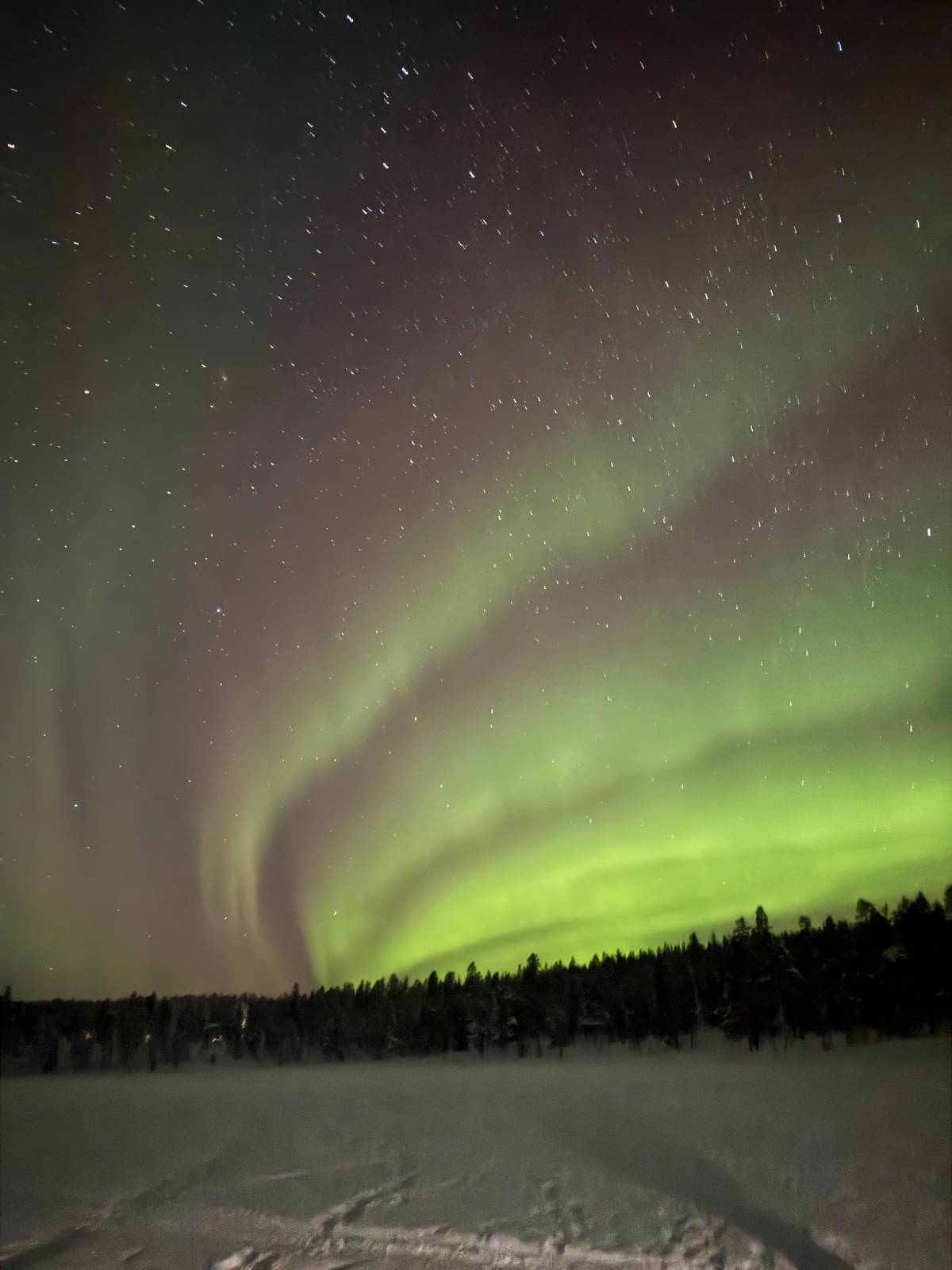 Free, live
Saariselkä streams
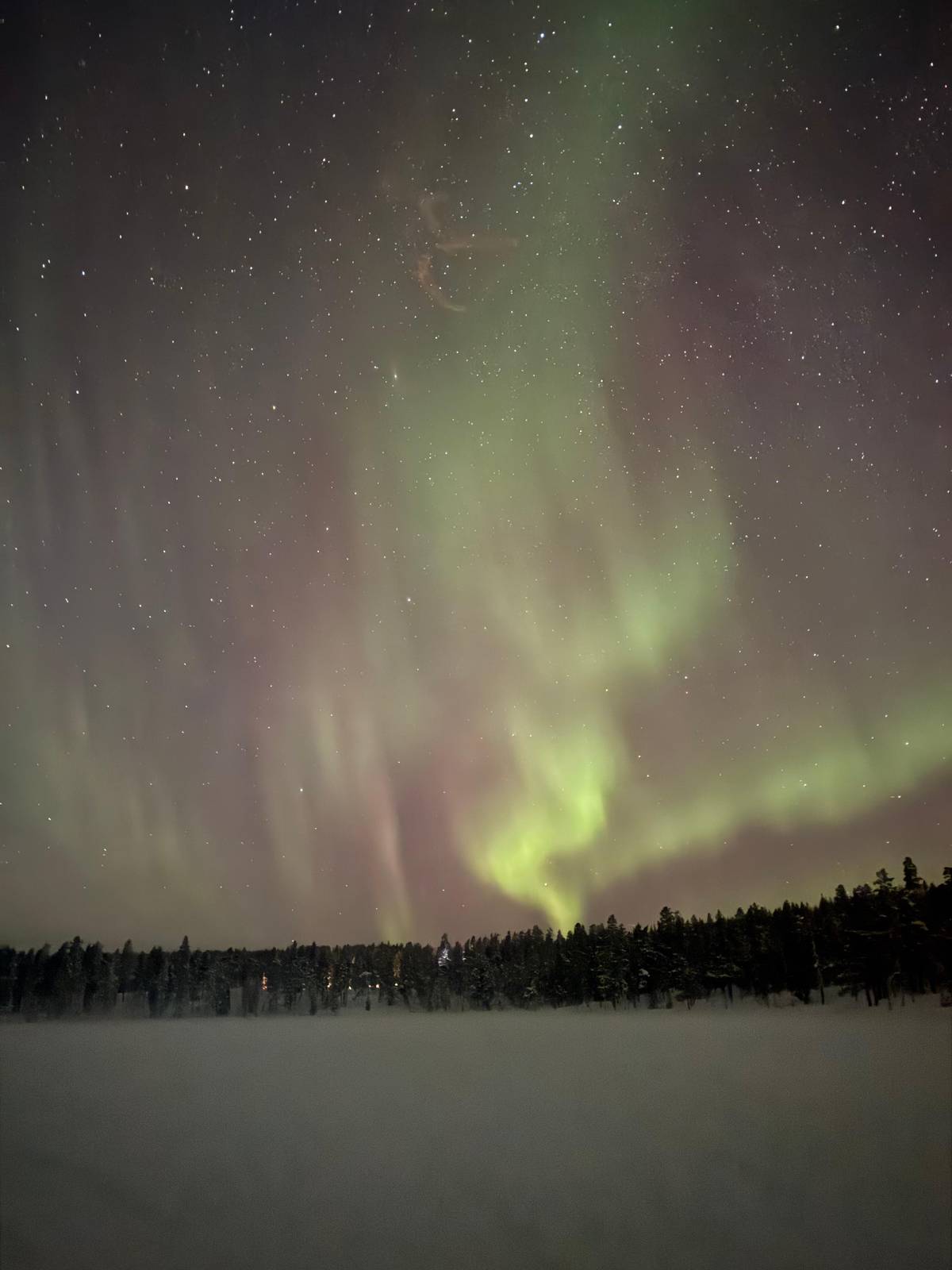 Booked here
Minivan from Saariselkä
Go or stay in
Match the sky to a plan for the evening
In northern Lapland a reading of 1-2 might be enough.2
Under the oval, Kp 3 or 4 can bring very nice displays.9
Dense cloud cover hides auroras from the ground; a vehicle can search for gaps.1
Clouds are the most common reason people miss the lights, and gaps come and go.17
That is a G 1 minor storm, with aurora commonly visible at high latitudes.11
When the upper threshold is exceeded, it is very likely that one can see auroras.
The Finnish Meteorological Institute publishes its own measure, the R-index, named after revontuli, the Finnish word for the aurora borealis.18 It is built from magnetometer stations across Finland, and one of them stands at Ivalo, north of Saariselkä on the road to Inari, in operation since 2001.5 When the Ivalo bar changes color, the sky over this part of Lapland is stirring, whatever the national headlines say.
FMI set its thresholds from 146,747 pictures taken by aurora cameras at Kevo, Muonio and Hankasalmi, which showed 463 hours of displays.19 Its Finnish guide explains what the levels mean: the lower threshold matches about a 50 percent chance of faint, weak auroras, and the upper one about a 50 percent chance of bright or extensive ones.20 Yellow is a nudge to look outside; above the upper line it is very likely you can see something.3
FMI's three-night forecast is a different tool. It rates the aurora probability on a four-step scale, from low to high, for the three nights after the forecast is made.15 Mind its limits: it does not account for cloudiness, and it describes the area south of the usual auroral zone, roughly south of Rovaniemi.16 For Saariselkä, the station readings and a local cloud forecast tell you far more on the day.
Checklist
Video
The player stays empty until you press play.
For planning a few days ahead, NOAA's 3-Day Geomagnetic Forecast is the usual reference. It is issued daily and includes deterministic Kp forecasts for each 3-hour period of the next three days.13 Look for raised numbers that fall in the local evening and the hours after midnight, rather than a single peak in the middle of the afternoon, when the sky over Lapland is still light or busy with twilight.
Further out, NOAA's 27-day Space Weather Outlook, issued Mondays by 1500 UTC, lists the largest daily K values expected, alongside the solar radio flux and the planetary A index.14 It is a coarse tool. Still, it can flag an active stretch worth building a trip around, or nudge you to add a spare evening to a booking you are about to make. Treat it as a calendar hint rather than a promise, and check again closer to the date.
Keep expectations in proportion. A forecast of activity is not a forecast of what you will see, since dense cloud can still hide the lights from the ground.1 Use the long-range numbers to choose which evenings to keep free, and the short-range cloud picture to choose which one to spend outside. The combination beats either source on its own, and it costs nothing but a few minutes each afternoon.
A live picture answers the question no index can: is anything happening right now? The camera block on this page follows live streams in Saariselkä whenever they are on air, one looking out from Kaunispää fell over the village and the open sky, another along a lit ski track near the village. Kaunispää is Saariselkä's most recognizable fell, and its peak stands at 438 metres.21 Streams go off air at times, and the block then says so.
Use a northern lights webcam in Finland the way a guide uses a call to a colleague: as a check, not a substitute. A faint arc can look like nothing on a small screen, and a bright display can be washed out by the village lights in the frame. If the camera shows green above the trees, step outside and look north. If it shows only grey, check the cloud panel before you decide the evening is lost.
Cameras also help you learn the sky. Compare what the stream shows with the activity and cloud readings on the same evening, and you will soon see how often a modest index still lights up the north on a clear night. FMI's advice holds for the real thing: give your eyes about half an hour in the dark, since human night vision is not very good.8 The camera is a teacher; the real sky is the exam.
Start in the afternoon, while there is still light to plan by. Check how much cloud is due over the evening and the small hours, and only then the activity figures. If the sky is forecast to stay closed, a hunt by vehicle can still find gaps, while a walk from your door has fewer options. If it looks clear, plan to be out around the time FMI calls typical for displays: midnight, give or take a couple of hours.4
Visit Finland gives a slightly earlier window, typically between 9pm and 2am, and NOAA places the best aurora between 10 PM and 2 AM local time.2223 Inside that window, find an unrestricted view toward the northern horizon, away from the lights of the village.7 A frozen lake or an open fell top serves far better than a street between hotels and parking lots. Switch off your phone's flashlight, too.
If you book the aurora hunt from this site, the guide does the reading for you. Its listing names expertise and planning, transportation and knowledge of the best locations, and pickup in the Saariselkä area. As on any tour, the northern lights cannot be guaranteed, and cancelling is free with 24 hours of notice. Your own warm clothing, hat and gloves are on its bring list.
Chasing the highest Kp is the classic error this far north. Under the oval, Kp 3 or 4 can already bring very nice displays, and Visit Finland says 1-2 might be enough in northern Lapland.92 Waiting for a storm can mean sitting out a quiet, clear evening that would have delivered a fine arc over the fells while you were refreshing a forecast app indoors. A clear sky is the part you cannot order.
The next mistake is trusting a forecast built for somewhere else. FMI's probability forecast covers the area roughly south of Rovaniemi and leaves clouds out, which makes it a weak guide for Saariselkä on its own.16 Read the local cloud cover and the nearby station readings instead, and treat national headlines about storms, good or bad, with some caution. Local beats national, every time.
The last is giving up too early. Clouds are the most common reason people miss the Northern Lights entirely, according to Visit Finland, but cloud moves.17 A gap can open late after a grey evening. Check the live panel again before bed, keep your boots and warm layers by the door, and step out for a look on any night the forecast leaves room for luck. A late look costs little and sometimes pays.
Plan your night
Claim a seat in the minivan now, pay nearer the night, and back out free until 24 hours before.
Less than you might think. Visit Finland says 1-2 might be enough in northern Lapland; NOAA mentions very nice displays at Kp 3 or 4 under the oval.29
Only loosely. It leaves cloud out and describes the area roughly south of Rovaniemi.16
Auroras are possible but usually dim. Above the upper threshold it is very likely that auroras can be seen.3
A few days. NOAA's 3-Day Geomagnetic Forecast gives Kp for each 3-hour period of the next three days.13
Usually clouds. Clouds are the most common reason people miss the lights, and dense cover hides them from the ground.171
Around midnight. FMI calls midnight, and a couple of hours either side, the typical time for displays.4
Only while its stream is live. The page shows a camera whenever a Saariselkä stream is on air, and says so when none is running.
Sources
Keep reading